
Orchestration& Arranging
Songwriting & Composition Track · Advanced Program
Master the art of writing for instruments and ensembles — from string quartets to full orchestras to virtual mockups.
The Certificate in Orchestration & Arranging at The Global Conservatory is an advanced, hands-on immersion in the craft of turning musical ideas into living, breathing scores. You will learn to write idiomatically for every instrument of the orchestra, arrange for ensembles from chamber groups to big bands, and produce concert-ready MIDI mockups using industry-standard virtual instruments.
This is where melody meets mastery. Guided by active orchestrators, film composers, and arrangers, you will develop the ear, the technique, and the creative vision to bring any musical idea to its fullest sonic realization — on paper, on screen, and on stage.
Our Approach
Orchestration is the art of giving music a body. A melody is just a thought until an orchestrator decides whether it should sing on a solo oboe, soar through massed strings, or thunder across full brass and percussion. That decision — that alchemy — is what we teach.
From the treatises of Rimsky-Korsakov to the cinematic palettes of today's greatest film composers, orchestration has always been the bridge between imagination and sound. This program places you in that lineage — studying the masters while forging your own orchestral voice.
Focus Areas
Three Core Disciplines
Each track builds toward complete command of instrumental writing, ensemble arranging, and modern production techniques for orchestral music.
Orchestral Writing
Strings, woodwinds, brass, percussion, and full orchestra. Master idiomatic writing for every section and learn to combine them into powerful tutti textures.
Arranging for Ensembles
Big band, chamber ensembles, vocal arranging, and hybrid groups. Translate any musical idea into a polished arrangement for any combination of performers.
Modern Orchestration
Virtual instruments, sample libraries, MIDI mockups, and hybrid scoring. Bring your orchestral vision to life in the digital domain with professional-grade realism.

Orchestral Core
Writing for Strings
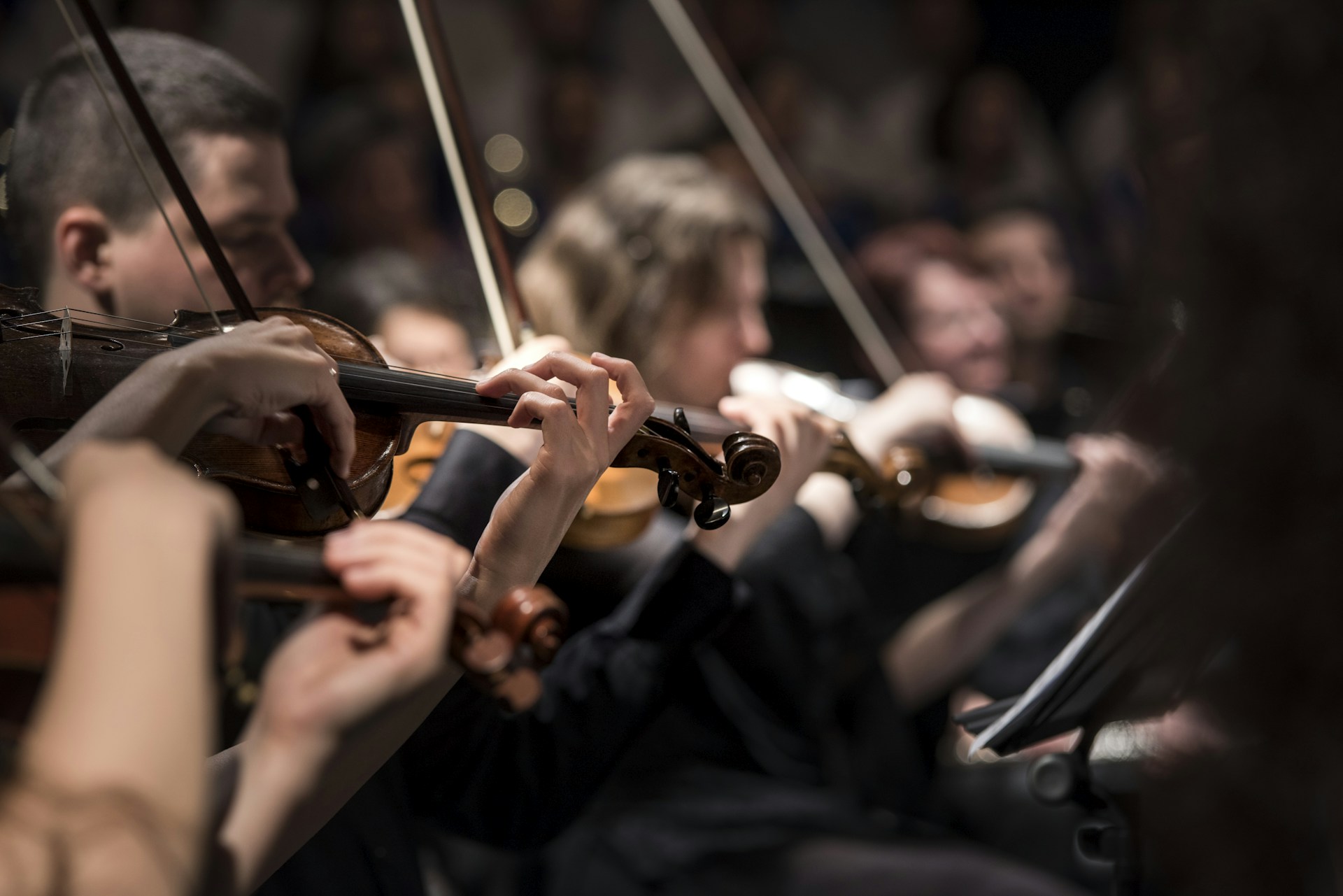
The string section is the backbone of the orchestra. You will develop deep fluency in writing for violin, viola, cello, and double bass — not just their ranges, but their characters, colors, and physical capabilities. Every bowing, every harmonic, every divisi passage will be grounded in real-world playability.
- Violin, viola, cello, and bass ranges, transpositions, and clefs
- Bowing techniques: legato, spiccato, tremolo, col legno, sul ponticello
- Divisi writing, double stops, and harmonics
- String section voicing and tutti vs. solo textures
The strings are where orchestration begins — and where sensitivity is everything.
Color & Power
Woodwinds & Brass
Woodwinds bring color, agility, and intimacy. Brass brings power, grandeur, and ceremony. Together they define the character of the orchestra. You will learn to write idiomatically for each instrument, manage transpositions with confidence, and exploit doublings that create new timbral combinations.
- Flute, oboe, clarinet, bassoon families and their extended ranges
- Horn, trumpet, trombone, tuba — power, range, and endurance
- Transposing instruments and concert pitch fluency
- Doubling strategies and wind-brass blending techniques
Master the colors of wind and brass, and the entire palette of orchestral expression opens to you.

Inspired By Giants
The Orchestrators Who Defined the Art
These masters didn't just write for orchestra — they expanded what the orchestra could say. Their innovations in color, texture, and dramatic power are woven into every module of this certificate.
"The art of orchestration is the art of making the orchestra sing."— Nikolai Rimsky-Korsakov
Nikolai Rimsky-Korsakov
Classical / Orchestral
Wrote the foundational orchestration treatise, Scheherazade
Maurice Ravel
Impressionist / Orchestral
Supreme colorist, orchestrated Mussorgsky's Pictures at an Exhibition
Samuel Adler
Academic / Pedagogical
The Study of Orchestration, the definitive modern textbook
John Williams
Film Scoring
Star Wars, Jurassic Park, unmatched orchestral storytelling
Anne Dudley
Film / Pop Orchestration
Oscar-winning composer, Art of Noise, orchestral-pop pioneer
Ennio Morricone
Film Scoring
The Good, the Bad and the Ugly, over 500 film scores
Duke Ellington
Jazz Orchestration
Revolutionary big band orchestrator, pioneered jazz voicings
Maria Schneider
Jazz / Orchestral
Grammy-winning jazz orchestrator, redefines large-ensemble writing

Texture & Effect
Percussion & Color Instruments
Percussion is the heartbeat of the orchestra, and the color instruments — harp, celeste, piano — add shimmer, depth, and otherworldly texture. You will learn to write for timpani, snare, bass drum, cymbals, xylophone, marimba, vibraphone, glockenspiel, tubular bells, and a full range of auxiliary percussion.
- Pitched percussion: timpani, xylophone, marimba, vibraphone, glockenspiel
- Unpitched percussion: snare, bass drum, cymbals, triangle, tam-tam
- Harp pedaling, piano in orchestral context, celeste and keyboard percussion
- Special effects: wind machine, thunder sheet, anvil, whip, ratchet
Great percussion writing turns a good score into an unforgettable one.
Digital Mastery
Virtual Orchestration
In today's industry, the ability to produce a convincing orchestral mockup is as important as writing the notes themselves. You will build professional DAW templates, learn sample library programming from legato patches to short articulations, and master the art of humanization — making MIDI performances breathe like real players.
- Sample libraries: selecting, organizing, and combining for realism
- MIDI programming: velocity layers, expression, modulation, keyswitches
- Humanization techniques: timing, dynamics, and breath simulation
- Template building: routing, bus architecture, and mix preparation
Your mockups should make directors forget they aren't hearing a live orchestra.

Full Curriculum
What You'll Learn
Six intensive modules covering every dimension of orchestration and arranging — from individual instrument technique to full-score mastery.
String Orchestration
- Individual string instrument ranges and techniques
- Section writing: divisi, unison, and solo passages
- Bowing notation and articulation marks
- String quartet and string orchestra scoring
Woodwind & Brass Writing
- Transposition and concert pitch fluency
- Wind choir and brass choir voicings
- Instrument pairing and timbral blending
- Writing for wind ensemble and concert band
Percussion & Special Instruments
- Timpani tuning, rolls, and pedal changes
- Mallet percussion and keyboard percussion
- Harp pedaling and glissando technique
- Auxiliary percussion and special effects
Jazz & Pop Arranging
- Big band voicings: sax soli, brass shout, ensemble tutti
- Rhythm section writing and lead sheets
- Vocal arranging: SATB, close harmony, background vocals
- Pop/rock string and horn section arrangements
Score Preparation & Notation
- Full score layout and transposed vs. concert pitch scores
- Part extraction and proofreading
- Notation software mastery (Sibelius, Dorico, MuseScore)
- Copyist standards and professional score presentation
Virtual Orchestra Programming
- Sample library selection and template architecture
- MIDI mockup workflow and articulation mapping
- Mixing orchestral samples for realism
- Hybrid scoring: combining live and virtual elements
"Orchestration is not decoration. It is the substance of the thought itself."
— TGC FacultyYour Final Deliverables
Capstone Portfolio
Your capstone is a multi-format portfolio demonstrating mastery of orchestral writing, ensemble arranging, and virtual production. Each project targets a different scoring context — proving your versatility and readiness for professional orchestration work.
- Full orchestral score for symphony or large ensemble
- Chamber arrangement for mixed ensemble (3–8 players)
- Big band chart with full parts and score
- MIDI mockup portfolio with virtual orchestra demo
- Score analysis paper on a major orchestral work
Certificate & Badges Awarded
Certificate of Completion
Orchestration & Arranging — The Global Conservatory
Digital badges in:
Your 6 Months
The Program Timeline
A structured journey from individual instrument study to full-score mastery in four intensive phases.
Strings & Woodwinds
Deep study of string writing techniques and woodwind families. Individual instrument mastery and section scoring. Months 1–2.
Brass, Percussion & Full Orchestra
Brass writing, percussion scoring, and full orchestral tutti. Score reading and analysis of major works. Months 2–3.
Arranging & Virtual Orchestration
Jazz and pop arranging, vocal writing, sample libraries, and MIDI mockup production. Cross-genre fluency. Months 4–5.
Capstone Scores
Complete your capstone portfolio: orchestral score, chamber arrangement, big band chart, and virtual demo. Faculty review. Months 5–6.
Student Voices
What Graduates Say
Real feedback from composers who completed the Orchestration & Arranging certificate.
"I came in writing piano sketches. I left writing for full orchestra with confidence. The string writing module alone transformed how I hear music. Every assignment was reviewed with extraordinary detail."
"The balance between traditional orchestration and modern virtual production was exactly what I needed. My MIDI mockups now sound indistinguishable from live sessions. Directors are impressed."
"As a jazz musician, the big band arranging and vocal writing modules were revelatory. But learning orchestral scoring opened an entirely new world of professional opportunity for me."
Questions
Frequently Asked Questions
Your Weekly Learning Rhythm
A structured cadence designed to build mastery through consistent practice, expert feedback, and peer collaboration.
Apply Now
Request Information
Ready to master orchestration and arranging? Complete this form and our admissions team will connect with you to discuss the program, assess fit, and answer your questions.
Give Music a Body.
Your orchestral voice is waiting. Join The Global Conservatory's Orchestration & Arranging certificate and learn to write music that lives and breathes through every instrument of the ensemble.
About This Credential
The Global Conservatory issues professional certificates and credentials. TGC certificates are non-degree credentials designed to validate specialized skills and knowledge. They do not represent academic degrees, college credits, or accredited diplomas. For questions about credential recognition, visit our credential verification page.
Start Your Journey
Ready to Enroll?
Submit your interest and our admissions team will contact you with program details, pricing, and next steps.
No commitment required. Financial aid available for qualifying students.