
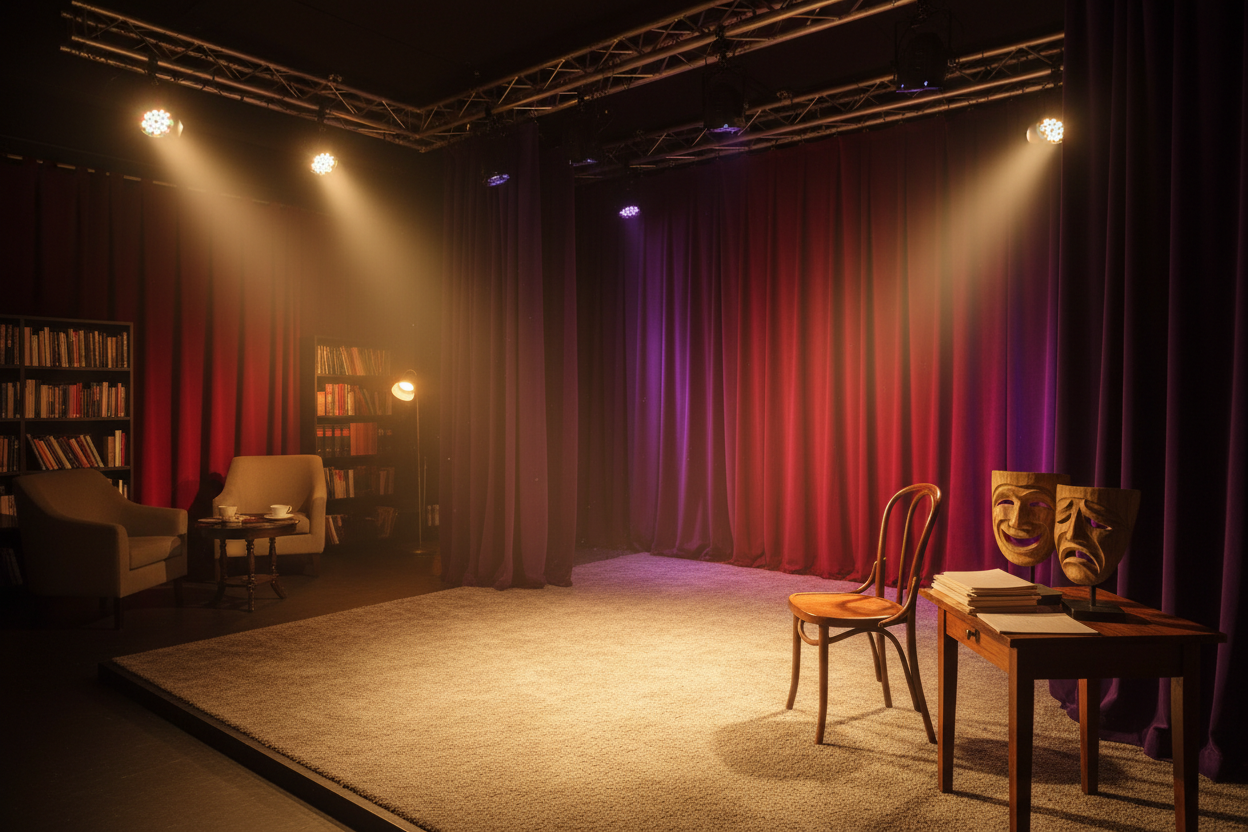
Drama Division / Private Lessons
Drama Private Lessons
One-to-one conservatory training in acting, voice, movement, directing, and writing — tailored entirely to you.
The oldest form of actor training, rebuilt for a global stage
Before there were conservatories, before there were drama schools, before there were classes of any kind — there was a single teacher and a single student. An experienced actor passing on the craft to a younger one. A master voice teacher sitting with a performer, listening, diagnosing, guiding. A playwright working one-on-one with an actor to find the truth in a scene.
This is the oldest and most direct form of artistic training in existence. It is also the most effective. Every major performer in history — from Richard Burbage learning his craft in the Lord Chamberlain's Men to Marlon Brando working with Stella Adler, from Judi Dench being coached by Cicely Berry to Adam Driver training privately at Juilliard — has been shaped by one-to-one work with a master teacher.
The Drama Division's private lessons carry this tradition forward. You meet regularly with a faculty member who knows your voice, your habits, your strengths, and the specific goals you are working toward. Every session is designed around you — your material, your level, your career. This is not a class you attend. It is a relationship you build.
Why one-to-one training matters
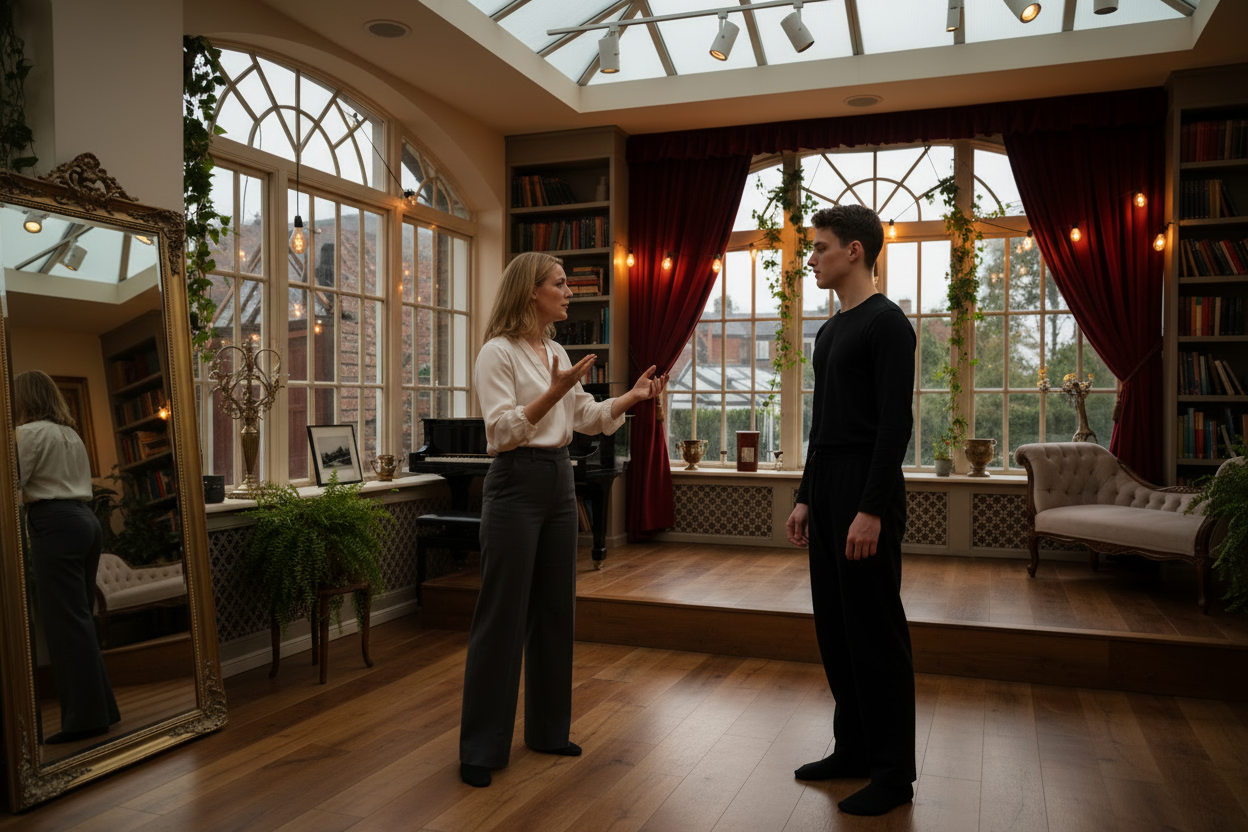
In a class, you learn in public. In a private lesson, you learn in safety. Both are essential — but they do different things.
A class teaches you to perform under the eyes of others, to be brave in front of an ensemble, to give and receive feedback in a group. These are skills every actor needs. But a class cannot stop the room to spend forty-five minutes on the particular tension in your jaw that closes down your voice every time you hit a high emotional moment. A class cannot rebuild your specific audition package for the three schools you are applying to. A class cannot work through a scene partner issue, a self-tape anxiety, or a vocal habit that has been with you since childhood.
Private lessons can. And they do.
"The voice should be freed, not built. Each person's voice has been shaped by their life — their fears, their joys, their inhibitions. The teacher's job is to help them release what is already there." Kristin Linklater — Freeing the Natural Voice
Linklater's insight applies far beyond voice work. Every discipline in drama — acting technique, scene study, on-camera work, movement, writing — benefits from the private lesson's fundamental structure: one experienced artist giving undivided attention to one developing artist, working at the pace and depth that only a one-to-one relationship allows.
What makes our private lessons different
Private drama coaching exists everywhere — in every city, on every tutoring platform. What makes the Drama Division's private lessons different is context.
Our faculty are not independent freelancers working in isolation. They are members of a conservatory. They teach within a shared pedagogical framework. They can recommend that a student add a class, attend a masterclass, or enter an audition program — and those options exist within the same institution. A private lesson at The Global Conservatory is not a standalone event. It is the anchor point of a larger training architecture, designed to work alongside group studios, masterclasses, and audition preparation.
This is how the great conservatories have always worked. At Juilliard, at Yale, at RADA — private coaching is not separate from the institution. It is embedded within it. We follow the same model, delivered live online with faculty drawn from the international stage.
A brief history of the private acting lesson
The private lesson in drama has a lineage as old as the art form itself. In Elizabethan England, boy actors learned their craft through private apprenticeship with senior company members — Richard Burbage coaching the boys who would play Juliet, Ophelia, and Lady Macbeth. There was no other way to learn. You watched, you imitated, you were corrected, and you grew.
When Stanislavski developed his System at the Moscow Art Theatre, much of the deepest work happened in private sessions — the detailed exploration of a character's inner life, the careful dismantling of an actor's habitual tensions. His students Boleslavsky and Ouspenskaya brought this tradition to America, where it took root in the private studios that defined twentieth-century American acting: Strasberg's private sessions at the Actors Studio, Stella Adler's legendary one-to-one work with students like Brando and De Niro, Meisner's decades of individual coaching at the Neighborhood Playhouse.
In the voice world, private coaching has always been central. Cicely Berry worked privately with actors at the RSC for forty-five years — sitting with them, listening, pushing them physically against walls while they spoke verse, helping them find the muscular reality of Shakespeare's language in their own bodies. Kristin Linklater's "Freeing the Natural Voice" methodology was designed for the intimate, individual encounter — a teacher and student exploring breath, resonance, and emotional openness together.
The great acting coaches of the modern era — Patsy Rodenburg, Larry Moss, Ivana Chubbuck, Howard Fine — all built their reputations primarily through private work. The public masterclass may be what audiences see. The private lesson is where the real transformation happens.
Ten disciplines, each with its own tradition
Every discipline below can be studied as a private lesson. Faculty profiles indicate which areas they teach, and students can filter by discipline, style, language, and time zone.
Building a reliable, repeatable acting process. Truthful behavior under imaginary circumstances. Work may draw from Stanislavski, Meisner, Adler, Chekhov technique, Practical Aesthetics, or contemporary approaches — tailored to the individual student.
Typical work: Monologues, cold reads, sense memory, character analysis, given circumstances, objectives and actions, rehearsal process.
Working deeply with scripted material — from Greek tragedy and Shakespeare through Chekhov, Williams, Miller, Albee, Churchill, Parks, and contemporary playwrights. The teacher and student select scenes together, analyze the text, and build performance through repeated rehearsal.
Typical work: Two-person scenes (with teacher reading partner), monologue prep, beat analysis, script scoring, through-line mapping.
Breath support, resonance, articulation, projection, and text work. Drawing from the Linklater tradition (freeing the natural voice), Cicely Berry's physical text approach, and Fitzmaurice Voicework. Accent and dialect coaching available.
Typical work: Breath exercises, resonance exploration, articulation drills, verse speaking, IPA notation, dialect acquisition, warm-up design.
Body awareness, alignment, presence, gesture, and expressive physicality for stage and camera. Informed by Alexander Technique, Laban Movement Analysis, Viewpoints, Suzuki Method, and stage combat principles.
Typical work: Tension release, spatial awareness, physical characterization, Effort studies, neutral mask principles, movement scoring for scenes.
Adjusting performance for the lens: framing, eye-lines, continuity, and the intimate scale of camera acting. Self-tape technique — lighting, sound, framing, and the specific performance adjustments required when the camera is six feet away.
Typical work: Self-tape recording and review, cold read practice, audition sides, reel building, callback prep, on-camera scene work.
Acting through song. Building and refining audition books. Integrating vocal technique with acting choices. Repertoire selection across styles — Golden Age, contemporary, pop/rock. For the "triple threat" who needs to act, sing, and move as one instrument.
Typical work: 16- and 32-bar cuts, full songs, acting the lyric, book selection, audition package building, MT dance combination prep.
Working with actors, analyzing scripts for production, staging, visual storytelling, and rehearsal room leadership. Suitable for emerging directors, actor-directors, and students preparing directing portfolios for graduate school applications.
Typical work: Production concept development, script analysis for directors, staging exercises, rehearsal planning, portfolio review.
Developing plays, screenplays, pilots, solo shows, and devised text. Structure, dialogue, character, world-building, and revision. One-to-one mentorship with working writers who understand both craft and industry.
Typical work: Scene-by-scene drafting, table reads, dramaturgical analysis, portfolio building, submission prep for festivals and competitions.
Structured one-to-one preparation for drama school auditions (BFA, BA, MFA), musical theatre programs, professional casting, and self-tape submissions. Monologue and song selection, mock panels, interview coaching, and school-specific guidance.
Programs coached for: Juilliard, Carnegie Mellon, NYU Tisch, RADA, LAMDA, Yale, CalArts, Boston Conservatory, and many more.
Age-appropriate one-to-one training for younger actors (ages 10–18). Building genuine technique and confidence beyond casual school drama. For serious pre-college students, this is focused preparation for the conservatory application pipeline.
Typical work: Monologue selection, acting fundamentals, vocal warm-ups, audition prep, confidence building, and performance skills.
What students actually do in private lessons
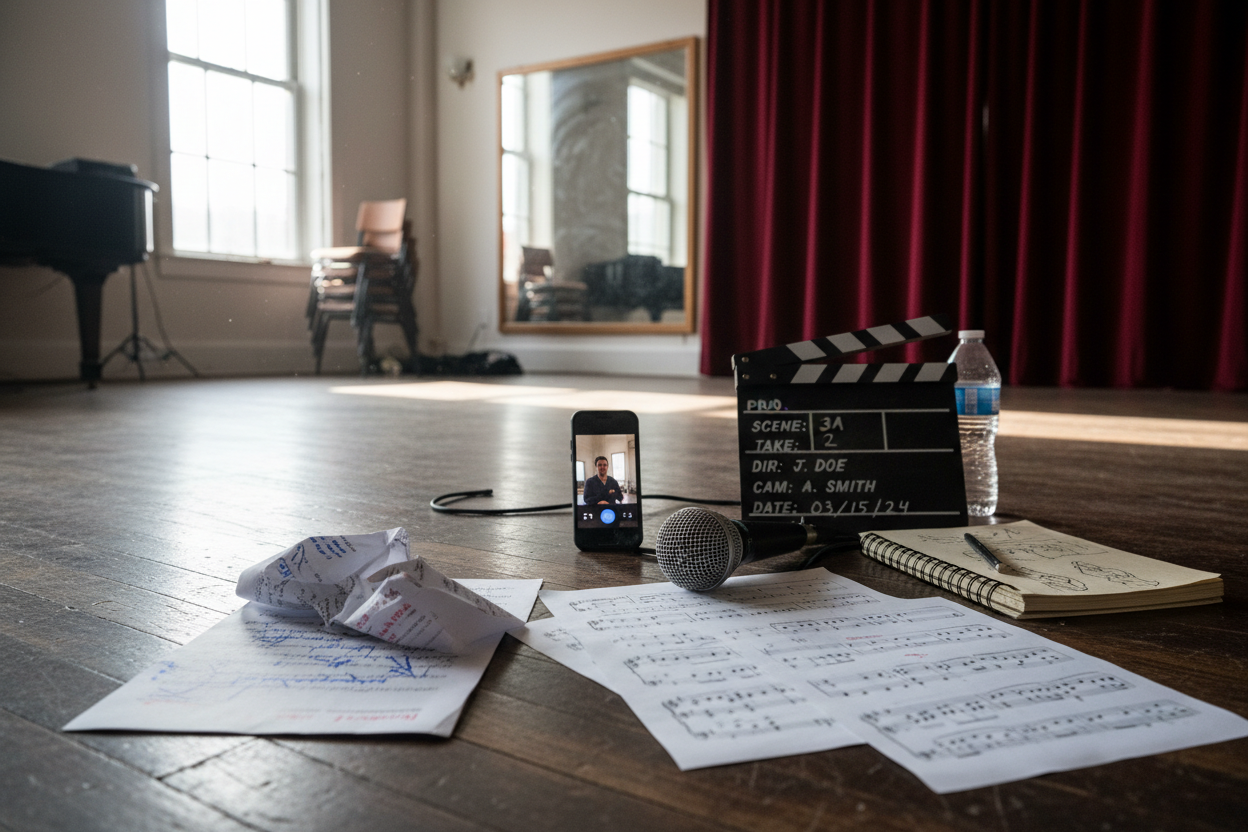
This is not abstract. Here is what real students work on, session by session:
The Pre-College Student (age 16)
She is applying to five BFA acting programs next fall. In weekly 60-minute lessons, she and her teacher select two contrasting monologues — one classical, one contemporary — that showcase her range while matching each school's aesthetic. They work the monologues for breath, intention, and specificity. They practice the interview. They record and review self-tapes. By audition season, she has performed her material hundreds of times and can deliver it under any conditions.
The Working Actor in London
He has a callback for a television series next week. In a focused 90-minute session, he and his on-camera coach work the sides: finding the adjustments, testing choices, recording takes, reviewing playback. They address a tendency to indicate rather than live in the moment. They build three distinct approaches to the character so he can take direction in the room. He leaves with a polished self-tape and a clear plan for the callback.
The Musical Theatre Student in Seoul
She is building an audition book for American musical theatre programs. In weekly lessons, she and her teacher select songs across four styles — Golden Age, Sondheim, contemporary pop/rock, and a wild card. They work each song for acting beats, not just vocal technique. They practice 16-bar and 32-bar cuts. They rehearse transitions and slate technique. Her teacher — who has cast for Broadway productions — gives her the specific feedback that only industry experience can provide.
The Adult Beginner (age 42)
He always wanted to act but never had the opportunity. In bi-weekly lessons, his teacher starts with fundamentals: relaxation, sense memory, simple truthful behavior in imaginary circumstances. They work short, achievable scenes. They build a basic warm-up routine. Within three months, he has the technique and confidence to join a group scene study class — something that would have been terrifying without the private foundation.
The Voice & Speech Student
She is a trained actress with a vocal habit — a persistent catch in her throat under emotional stress that limits her range and causes fatigue. In weekly voice lessons rooted in Linklater technique, her teacher works with breath, resonance, and the specific physical patterns that produce the catch. They use Shakespeare's verse as a diagnostic tool — the demanding rhythm of iambic pentameter reveals exactly where her voice is free and where it is held. Over weeks, the catch loosens. The voice opens.
How drama private lessons work
The process is designed to make the first step easy and the ongoing relationship productive.

Lesson lengths, packages, and frequency
Choose the format that fits your goals, schedule, and budget. Real progress comes from consistent weekly or bi-weekly work — but every path is valid.
A one-off 45–60 minute lesson with a new teacher. Meet, work, and decide if the match is right before committing to ongoing study. No obligation.
Recurring lessons at the same time each week — the conservatory standard. Packages of 6, 12, or open-ended weeks. This is where real technique is built, layer by layer.
3–5 lessons clustered around a specific event: audition season, an important role, a self-tape deadline, or a conservatory application. High-intensity, goal-driven work.
Why drama private lessons here are different
Private drama coaching exists on every tutoring platform and in every major city. Here is what distinguishes the Drama Division's private lessons from independent coaching:
- Conservatory-level expectations. Faculty are selected for their artistry, their training credentials, and their teaching ability. This is serious training — not casual mentorship or motivational chatting. You will be challenged.
- Global faculty, multiple traditions. Our drama faculty represent European classical theatre, American film and television, musical theatre, experimental performance, and physical theatre traditions from around the world. A student in Singapore can study Meisner technique with a New York–trained actor. A student in Brazil can work on Shakespeare with an RSC-trained voice coach in London.
- Integrated with the division. Private lessons plug into the larger Drama Division ecosystem — group classes, masterclasses, and audition programs. Your teacher can recommend exactly what you need next, and those options exist within the same institution.
- Musical theatre and interdisciplinary crossover. Musical theatre students can combine drama private lessons with vocal coaching, instrument study, and dance training across other divisions. This is the advantage of being inside a full conservatory, not a standalone acting school.
- Custom pathways. No two students follow the same path. Your lessons are designed around your specific goals — whether that is a Juilliard audition, a Netflix self-tape, a voice that carries in a 1,200-seat house, or the confidence to step on stage for the first time at age fifty.
Who should consider private lessons first
Private lessons are recommended as the starting point for students in any of these situations:
- Students preparing for major auditions — drama school, musical theatre programs, professional casting, or self-tape submissions. Audition preparation is inherently individual work. No group class can build your specific package.
- Early-career professionals who need highly targeted feedback on specific material, roles, or skills. The working actor's schedule is unpredictable — private lessons offer the flexibility that a fixed class cannot.
- Current conservatory or university students who feel under-challenged, who need additional coaching in areas their program doesn't fully cover, or who want a different artistic perspective from outside their institution.
- Adult beginners who want to start correctly with strong fundamentals before entering a group class. Private lessons build the technique and confidence needed to thrive in an ensemble setting.
- Students with specific vocal, physical, or performance issues that require individual diagnosis and attention — a persistent tension, a speech pattern, a camera anxiety, a vocal limitation.
- International students who need English-language accent coaching, Shakespeare preparation, or guidance on the specific requirements of American, British, or Australian drama programs.
If you are unsure whether to start with private lessons or a group class, a brief consultation with a Drama Division advisor can help clarify the best entry point.

Also in the Drama Division
Explore the other offerings that complement private lessons
Start with a Single Lesson
Browse drama faculty, choose a focus, and browse our faculty. After that first session, you and your teacher design the path forward together.