
The Global Conservatory
Drama Division
Acting, musical theatre, directing, and writing — a full conservatory drama school, built for the world stage.
A full conservatory drama school, inside a global conservatory
The Drama Division is not a set of classes. It is a school — a complete, structured conservatory for actors, directors, writers, and theatre-makers, housed within The Global Conservatory and built from the same traditions that produced the finest performers of every generation.
What Juilliard, RADA, and the Yale School of Drama do on campus, we do live online: rigorous training in acting technique, voice and speech, movement, text analysis, on-camera work, and professional preparation. What we add is something no campus program can offer — access from anywhere in the world, to faculty drawn from the international stage, without requiring students to uproot their lives.
This is not a compromise. It is a different kind of institution — one that takes the conservatory model seriously enough to rebuild it for how actors actually train, audition, and work today.
The tradition you are entering
The art of the actor is the oldest of the performing arts. Before the orchestra, before the opera house, before the concert hall — there was a single performer stepping forward from the chorus to speak in the voice of another. That performer was Thespis, and the year was approximately 534 BCE, at the City Dionysia festival in Athens. The word "thespian" carries his name across twenty-five centuries.
What followed was the invention of drama itself. Aeschylus added a second actor and created dialogue. Sophocles added a third and gave the chorus its classical form. Euripides pushed toward psychological realism — characters driven by recognizable human emotion rather than divine decree. Aristophanes invented political comedy. Together, in less than a century, they established the fundamental structures that every play, film, and television script still follows: protagonist, antagonist, conflict, climax, resolution.
They performed in purpose-built amphitheatres that seated fourteen thousand people. The Theatre of Dionysus in Athens gave us the architectural vocabulary we still use: the theatron (the seeing place), the orchestra (the dancing place), the skene (the scene building). They performed in masks — not to hide, but to project character across vast distances, to allow a single actor to become many people, to make the internal visible.
This is the lineage. When you study acting, you are not learning a modern invention. You are entering a continuous tradition that stretches from the limestone amphitheatres of Greece to the rehearsal rooms of London, New York, Moscow, and Tokyo — and now, through this conservatory, to wherever you are.
Landmarks in actor training
Thespis Steps Forward
At the City Dionysia in Athens, Thespis becomes the first actor — stepping out from the chorus to speak as a character. The art of acting is born. The word "thespian" will carry his name for twenty-five centuries.
The Golden Age of Greek Tragedy
Aeschylus, Sophocles, and Euripides produce the foundational works of Western drama. Three actors, a chorus, masks, and the open sky — the essential grammar of theatre is established in Athens.
Roman Theatre & the Spread of Drama
Plautus and Terence adapt Greek comedy for Roman audiences. Seneca writes closet tragedies whose violent themes will profoundly influence the Elizabethans. Rome builds stone amphitheatres across its empire — the art of performance becomes an architecture of civilization.
Medieval Mystery & Morality Plays
After centuries of suppression, drama re-emerges through the medieval church. Mystery plays dramatize biblical stories on pageant wagons throughout England and Europe. Guild actors — carpenters, bakers, weavers — become the first civic performers. The tradition of community-based theatre takes root.
Commedia dell'Arte Transforms Europe
Italian troupes develop commedia dell'arte — the first professional actor-driven theatre. Masked stock characters (Arlecchino, Colombina, Pantalone), improvised dialogue around written scenarios, and touring companies that perform across borders. The modern idea of the professional actor-as-artist is born. Molière, Shakespeare, and countless others draw from commedia's well for centuries.
The Globe Theatre Opens
Shakespeare and the Lord Chamberlain's Men build the Globe on London's Bankside. Capacity: three thousand. No drama schools exist — actors learn through apprenticeship. Richard Burbage, Shakespeare's leading man, creates Hamlet, Othello, King Lear, and Macbeth in rapid succession. The company stages eleven performances of twelve different plays in a single fortnight.
Women Take the Stage
Charles II restores the English monarchy — and the theatres. For the first time in English history, women are legally permitted to perform on stage. The Restoration era brings proscenium arch theatres, painted scenery, and a new style of witty, urbane comedy. The actress emerges as a new cultural figure.
LAMDA Founded — the First Drama School
The London Academy of Music and Dramatic Art is established — the oldest drama school in the English-speaking world. For the first time, actors can pursue formal, structured training rather than learning solely through apprenticeship. The conservatory model begins. LAMDA's alumni will include Benedict Cumberbatch, Brian Cox, and John Lithgow.
The Moscow Art Theatre Opens
Stanislavski and Nemirovich-Danchenko found the MAT after an eighteen-hour meeting. Their production of Chekhov's The Seagull becomes a landmark. Stanislavski begins developing the "System" — the first systematic approach to actor training in history. The magic "if," given circumstances, the through-line of action, emotional memory — concepts that will reshape acting worldwide.
The Group Theatre & the American Method
Harold Clurman, Cheryl Crawford, and Lee Strasberg found the Group Theatre — America's first ensemble company dedicated to Stanislavski-based work. From this company emerge three divergent methods: Strasberg's emotional memory approach, Stella Adler's imagination-based technique, and Sanford Meisner's moment-to-moment truthfulness. Between them, they will train Marlon Brando, Robert De Niro, Al Pacino, Diane Keaton, Gregory Peck, and virtually every major American actor of the twentieth century.
Juilliard Drama Division Founded
John Houseman founds the Drama Division at Juilliard, integrating classical text, Linklater voice work, and intensive conservatory training. Alumni will include Robin Williams, Viola Davis, Adam Driver, Jessica Chastain, Oscar Isaac, and Kevin Kline. The modern conservatory model crystallizes.
Cicely Berry Joins the RSC
Cicely Berry is appointed the Royal Shakespeare Company's first voice director — a post she will hold for forty-five years. Her physical, muscular approach to Shakespeare's language revolutionizes how actors engage with classical text. She coaches Judi Dench, Ian McKellen, and Patrick Stewart, and publishes Voice and the Actor and The Actor and the Text — books that become essential reading worldwide.
Kristin Linklater Publishes Freeing the Natural Voice
Scottish-born voice teacher Kristin Linklater publishes the book that will become the most influential voice text in the English-speaking world. Her philosophy: the voice should be freed, not built — removing the physical and psychological blocks that prevent truthful expression. Her work becomes foundational at Juilliard, NYU, Columbia, and conservatories globally.
SITI Company & the Viewpoints
Anne Bogart and Tadashi Suzuki co-found SITI Company, merging Bogart's Viewpoints (a vocabulary for ensemble improvisation in time and space) with Suzuki's rigorous physical training drawn from Noh, Kabuki, and Greek theatre. Their collaboration opens a new chapter in actor training — the body and the ensemble at the center of performance.
The Global Conservatory: Drama Division
The same traditions — Stanislavski, Meisner, Adler, Linklater, Viewpoints — taught live by international faculty, accessible from anywhere in the world. A new kind of conservatory for a new generation of actors.
All of human nature, in five acts
There is a reason every serious drama program in the world — from RADA in London to Juilliard in New York to the National Institute of Dramatic Art in Sydney — requires Shakespeare. It is not nostalgia. It is not tradition for tradition's sake. It is because Shakespeare's text does something no other body of dramatic writing has ever done: it demands the complete actor.
To perform Shakespeare, you must master verse — iambic pentameter, the natural rhythm of English speech elevated to poetry. You must understand rhetoric — antithesis, repetition, imagery, the architecture of an argument built in real time. You must have a voice that can fill space without amplification, that can shift from a whisper to a roar within a single speech. You must move with precision. You must think on the line, not between the lines — Shakespeare's characters discover what they think in the act of speaking.
"Shakespeare is the greatest acting teacher there has ever been. His text contains everything an actor needs — the emotion, the psychology, the physical action, the rhythm. The actor's job is to find it, not to add it." Cicely Berry — RSC Voice Director, 1969–2014
This is why Cicely Berry spent forty-five years at the Royal Shakespeare Company teaching actors to feel the physical weight of Shakespeare's language in their bodies — pushing against walls while speaking, running while delivering verse, finding the muscular reality of consonants and the emotional openness of vowels. It is why Kristin Linklater built her life's work around "freeing the natural voice" — removing the physical and psychological blocks that prevent an actor's voice from carrying the full force of heightened text.
In the Drama Division, Shakespeare is not an elective. It is foundational. Students work with verse, with prose, with soliloquy and dialogue, with comedy and tragedy. They learn to scan a line, to breathe with the text, to let the language do the emotional work that lesser writing forces the actor to manufacture. This training transfers to everything — to Chekhov, to Tennessee Williams, to David Mamet, to the latest Netflix pilot. An actor who can handle Shakespeare can handle anything.
Three teachers, three paths to truth
In 1931, three young theatre artists — all students of Stanislavski's work — founded the Group Theatre in New York. Over the following decades, each developed a distinct approach to the central question of acting: how does a performer create truthful behavior under imaginary circumstances? Their answers diverged radically — and their methods now form the foundation of virtually all serious actor training in the English-speaking world.
Lee Strasberg & The Method
Strasberg believed the key was emotional memory — the actor's own lived experience, recalled and channeled into the character. Through exercises in sense memory, relaxation, and private moments, the actor learns to access genuine feeling on demand. The results could be volcanic. The Actors Studio, which Strasberg directed from 1951 until his death, produced Marlon Brando, James Dean, Al Pacino, Robert De Niro, and Dustin Hoffman.
Stella Adler & the Imagination
Adler studied directly with Stanislavski in Paris in 1934 — the only Group Theatre member to do so. She returned with news that Stanislavski himself had moved beyond emotional memory toward imagination and given circumstances. The actor's job is not to excavate personal trauma but to fully imagine the character's world. "The talent," she said, "is in the choices." Her students included Brando, De Niro, and Warren Beatty.
Sanford Meisner & Living Truthfully
Meisner redirected the actor's attention entirely outward — onto the scene partner. His famous Repetition Exercise trains actors to listen, respond instinctively, and live moment to moment without intellectual planning. "Acting is living truthfully under imaginary circumstances." He taught at the Neighborhood Playhouse for over fifty years. His students include Robert Duvall, Diane Keaton, Steve McQueen, and Sandra Bullock.
The Drama Division does not demand allegiance to any single method. We draw from all three — and from Chekhov technique, Viewpoints, Practical Aesthetics, and contemporary approaches. The goal is the same: truthful, compelling, repeatable performance. The path is shaped to the individual.
What you can study in the Drama Division
Within the division, students can commit deeply to one track or build a custom path that crosses several areas. Each pathway is supported by private lessons, small-group studios, masterclasses, and audition programs.

Core actor training: technique, scene study, monologues, voice, movement, and on-camera work for theatre, film, and television.

Integrated training in acting, singing, and dance. Acting through song, repertoire building, audition books, and movement for the stage.

Camera-specific acting, self-taping, audition tapes, reels, and work for film, TV, streaming, and digital media.
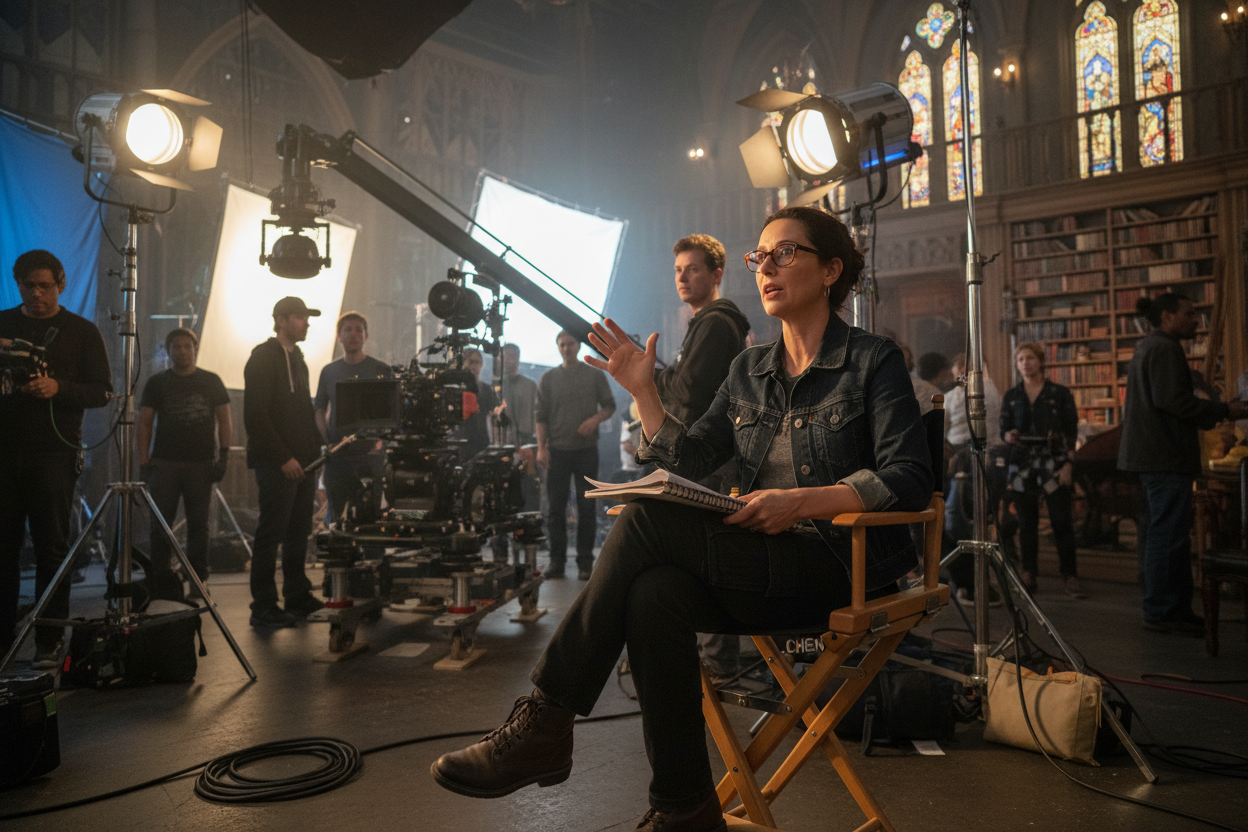
Working with actors, analyzing scripts, staging, visual storytelling, and leading rehearsals — both in theatre and on camera.

Writing for stage and screen: plays, pilots, screenplays, solo pieces, and devised text. Focus on structure, dialogue, and portfolio.
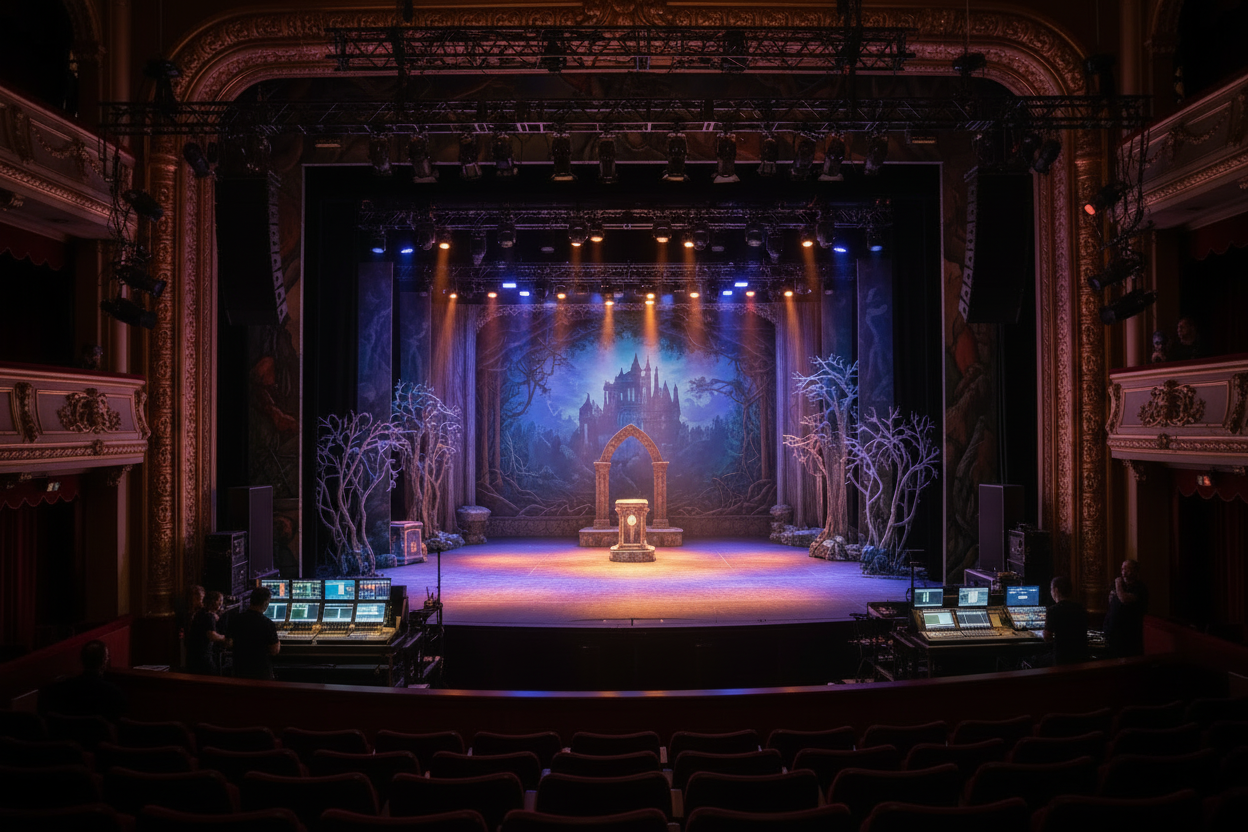
Scenic, costume, lighting, sound, and media design. Stage and production management for students who create worlds and run shows.
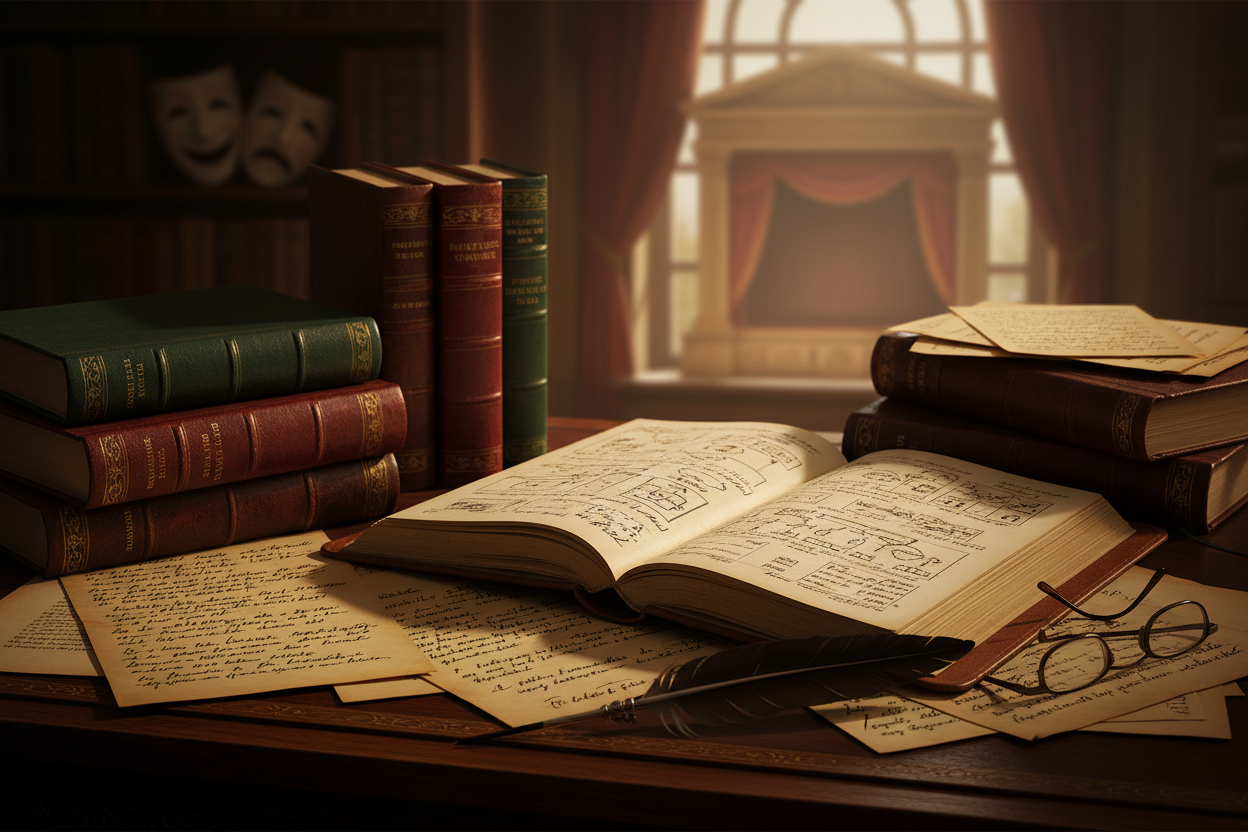
Theatre history, dramatic literature, text analysis, and dramaturgy for those who support productions through research and critical insight.

Age-appropriate training for younger actors and serious pre-college students preparing for conservatory and university auditions.

Breath, resonance, articulation, text work, accent and dialect. Drawing from Linklater, Berry, and Fitzmaurice traditions.
Each pathway is built from four offerings
No matter which area you study — acting, musical theatre, directing, writing, or any other pathway — the Drama Division delivers training through four complementary formats, each designed to develop a different aspect of the working artist:

Drama Private Lessons
One voice, one teacher, one conversation
One-to-one coaching in acting, voice and speech, movement, on-camera work, directing, or writing. Private lessons are the core of conservatory training — the place where individual problems are diagnosed, habits are broken, and technique is built from the ground up. Faculty work across time zones with flexible scheduling. A student in Tokyo can study Meisner technique with a faculty member in London. A young actor in São Paulo can prepare Shakespeare monologues with an RSC-trained coach in New York.
Explore Private Lessons →
Drama Classes & Studios
The ensemble is the instrument
Small-group courses (typically four to twelve weeks) in acting technique, scene study, Shakespeare and classics, on-camera acting, devising, musical theatre repertoire, and more. Studios are structured like conservatory workshops: weekly meetings, clear expectations, and continuous work in front of others. This is where actors learn to listen, to be watched, to take risks and fail in a supported environment — the essential conditions for growth that private study alone cannot replicate.
Explore Classes & Studios →
Drama Masterclasses & Special Events
The master artist in the room
One-off or short-series masterclasses with guest artists: actors, directors, playwrights, casting directors, designers. These are high-intensity sessions focused on a specific topic — a particular monologue, a casting technique, a directorial approach, a playwriting structure. The masterclass tradition goes back centuries: the experienced artist works publicly with students while observers learn from the exchange. Select events are added to a secure Drama Vault for replay access where licensing allows.
Explore Masterclasses →
Drama Auditions & Conservatory Prep
The room where it happens
Drama's dedicated audition wing: structured training for drama school and musical theatre auditions, professional theatre and on-camera casting, and youth and pre-college auditions. Programs include intensives, audition studios, mock panels, and self-tape clinics. For pre-college students, this is focused preparation for BFA, BM, and BA auditions at the major conservatories — monologue selection, repertoire coaching, interview technique, and the specific requirements of programs like Juilliard, Carnegie Mellon, NYU Tisch, and RADA.
Explore Auditions & Prep →
The pillars of drama training
No matter which pathway or format a student chooses, the Drama Division rests on a shared foundation of core skills. These are the disciplines that every serious conservatory teaches — and every working actor needs.

Who the Drama Division is for
The division is designed to serve serious students at every stage of development. Placement, pacing, and repertoire are adjusted to match age, experience, and goals.
Young Actors (ages 10–18)
Students looking for structured entry into real training — beyond casual school plays and community theatre. The Drama Division offers age-appropriate conservatory work: acting technique, scene study, monologue preparation, and ensemble experience that builds genuine skill and confidence. For those considering a future in theatre or film, this is where the foundation is laid.
Pre-College Students
Students preparing for auditions to BFA, BM, BA, or international drama and musical theatre programs. The conservatory application process is demanding and specific — each school has its own requirements, repertoire expectations, and aesthetic values. Our faculty includes members who have taught at and auditioned for these programs. They know what panels are looking for because they have sat on them.
University & Conservatory Students
Current drama students who want additional coaching, on-camera work, a different artistic perspective, or supplementary training in areas their program does not fully cover. Many conservatory students find that private coaching outside their institution — particularly in audition preparation and self-tape technique — accelerates their development significantly.
Early-Career & Working Professionals
Actors and theatre-makers who need targeted support: new material, self-tapes, role preparation, expanded skills in on-camera or voice work, or coaching for specific auditions. The working actor's schedule is unpredictable — our flexible format allows professionals to train when and how they need to, without committing to a full-time program.
Adult Beginners
Adults who missed the traditional pipeline but are ready to train at a serious level now. Whether you are thirty or sixty, whether you have never set foot on a stage or have years of amateur experience, the Drama Division meets you where you are and builds from there. Acting is not a young person's art — it is a human art, and every decade of life brings new material to the work.
How study works in the Drama Division
The process is designed to be as serious and considered as a conservatory admission — but far more accessible.
How Drama connects to the rest of The Global Conservatory
The Drama Division does not exist in isolation. It sits within a full conservatory — alongside instrument and vocal programs, orchestral training, jazz, composition, conducting, ballet, and emerging technology. This creates possibilities that a standalone drama school cannot offer:
- With instrument and vocal programs: Musical theatre students can combine drama and voice or instrument coaching, working with the same level of vocal faculty available to opera and classical voice students.
- With the Orchestral Training Division: Composers and conductors can collaborate with playwrights, directors, and actors on new works — music-theatre, incidental scores, and original productions.
- With Jazz, Composition, and Electronic tracks: Creators can develop cross-genre performance, music-theatre, cabaret, and multimedia projects that break the boundaries between disciplines.
- With Ballet: Musical theatre performers gain access to serious dance training. Actors working in physical theatre or devised work can train in movement at a conservatory level.
- With NextGen Music & AI Technology: Students can explore new forms of digital theatre, interactive performance, film, and emerging media alongside technology specialists.
This is the advantage of a division, rather than a standalone school. The Drama Division gives you access to the full artistic ecosystem of The Global Conservatory — a resource no single-discipline institution can replicate.
Begin in the Drama Division
Each pathway opens through one of four entry points
One-to-one coaching in acting, voice, movement, on-camera, directing, or writing.
View → 02Small-group conservatory studios in technique, scene study, Shakespeare, and more.
View → 03Intensives with guest artists — actors, directors, playwrights, casting directors.
View → 04Structured training for drama school, musical theatre, and professional auditions.
View →Begin in the Drama Division
Whether you are preparing for your first audition or building an international career, the Drama Division meets you where you are.